

Accurate coding is the backbone of California workers’ compensation medical billing codes done right. Providers must document the services performed, identify the relevant diagnoses and report the right codes when billing for work-related injuries or illnesses. Three code sets do most of the work: CPT describes what was done, ICD-10-CM describes why and HCPCS covers certain supplies and equipment. Together with California-specific rules, they shape California workers’ compensation billing from start to finish. Strong coding helps reduce avoidable errors and reimbursement disputes, though it never guarantees payment.
1What Are Medical Billing Codes in California Workers’ Compensation?
Medical billing codes are standardized codes that tell a claims administrator which diagnoses, procedures and services a provider documented. Diagnosis and procedure codes work as a pair: one explains the condition, and the other explains the care.
In short, workers’ comp billing codes California providers submit must match the medical record. Complete medical billing documentation is what makes that match possible. California also applies rules from the California Division of Workers’ Compensation (DWC) and its fee schedules, so national coding guidance is only part of the picture.
2What Are CPT Codes in Workers’ Compensation Billing?
Current Procedural Terminology (CPT) codes describe medical, surgical, evaluation, and other professional services. CPT codes for workers’ compensation identify what the provider did, which makes them central to professional billing.
The code you choose must match the documented service, and modifiers or additional information may be required in some cases. For example, a documented office visit would be reported with an appropriate evaluation and management code, but the actual code depends on the service and applicable coding guidelines.
For many services, California’s Official Medical Fee Schedule (OMFS) may determine reimbursement. That is why procedure coding accuracy matters: a mismatched code can lead to an adjusted or objected bill.
3What Are ICD-10-CM Codes for Workers’ Comp Claims?
ICD-10-CM diagnosis codes describe a patient’s diagnosis, injury, or condition. ICD-10 codes for workers’ comp claims should reflect the provider’s documentation, not assumptions.
Specificity matters. Injury details, anatomical location and encounter information can all affect code selection. Following the applicable diagnosis coding guidelines keeps the bill aligned with what the medical record says, and that consistency helps prevent questions later. No single code fits every work-related injury, so avoid copying codes from similar cases.
4What Are HCPCS Codes and When Are They Used?
The Healthcare Common Procedure Coding System (HCPCS) includes Level I, which is CPT, and Level II codes used for certain supplies, equipment, drugs and services. Common uses include:
- Durable medical equipment (DME).
- Orthotics, prosthetics, and medical supplies.
- Applicable ambulance and transportation services.
- Certain drugs and other items billed with HCPCS or other required coding systems.
Level II codes may be used when a CPT code does not adequately represent an item or service. HCPCS codes California workers’ compensation claims rely on are still governed by the applicable California fee schedule and billing rules, which determine how an item is reported and reimbursed. CMS explains the system on its HCPCS page.
5Key Differences Between CPT, ICD-10-CM, and HCPCS
Code Set | Primary Purpose | Example of Use |
CPT | Describes procedures and professional services | Office visit or medical procedure |
ICD-10-CM | Describes diagnoses and conditions | Documented injury or medical condition |
HCPCS Level II | Identifies certain supplies, equipment, drugs, and services | Durable medical equipment or applicable medical supplies |
These code sets complement one another, but they are not interchangeable. The right combination depends on the service, diagnosis, documentation and applicable billing requirements.
6How Does California’s OMFS Affect Medical Coding and Reimbursement?
The applicable fee schedule determines reimbursement for covered service categories, so code selection must match the documented service. Different categories can use different reimbursement methods, and some California-specific codes or payment rules may apply to certain services. Never assume every code is paid by the same formula.
Check current fee schedule rules and effective dates before billing. The Medical Billing and Payment Guide and DWC fee schedule pages are the best references for California workers’ comp reimbursement. Correct coding supports payment, but it does not automatically guarantee it. See the DWC Medical Billing and Payment Guide information and electronic billing guidance, along with the DWC Physician’s Guide.
7Common Medical Coding Errors and How to Avoid Them
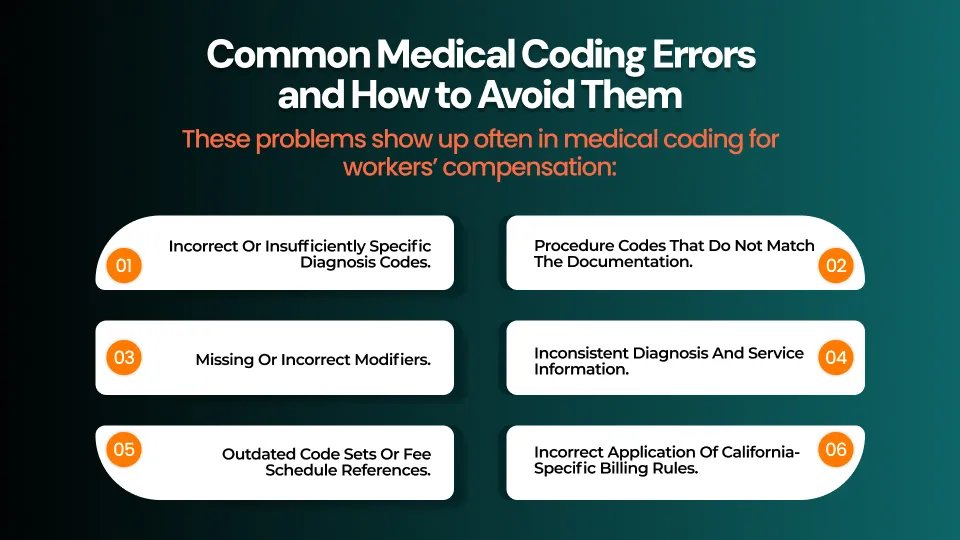
These problems show up often in medical coding for workers’ compensation:
- Incorrect or insufficiently specific diagnosis codes.
- Procedure codes that do not match the documentation.
- Missing or incorrect modifiers.
- Inconsistent diagnosis and service information.
- Outdated code sets or fee schedule references.
- Missing supporting documentation.
- Incorrect application of California-specific billing rules.
Any of them can slow workers’ compensation claim processing and lead to medical claim denials. Regular coding reviews, staff training, documentation checks, and steady claim follow-up all help. Practices with recurring problems may benefit from workers’ compensation billing services and denial management support, which also strengthen revenue cycle management (RCM).
8Frequently Asked Questions
1. What medical billing codes are used for California workers’ compensation?
CPT, ICD-10-CM, and HCPCS are commonly used, depending on the service, diagnosis, and applicable billing requirements.
2. What is the difference between CPT and ICD-10-CM codes?
CPT codes describe procedures and services, while ICD-10-CM codes identify diagnoses and medical conditions.
3. When are HCPCS codes used in workers’ compensation billing?
HCPCS Level II codes identify certain supplies, equipment, drugs, and services that CPT codes alone do not represent.
4. Does California have its own workers’ compensation billing rules?
Yes. California applies DWC medical billing rules and the applicable Official Medical Fee Schedule, including California-specific provisions where relevant.
5. Can incorrect medical coding delay workers’ compensation payments?
Yes. Coding errors can result in bill objections, adjustments, denials, or payment disputes, depending on the circumstances.
9Conclusion
Accurate CPT, ICD-10-CM, and HCPCS coding is essential to California workers’ compensation billing. Complete documentation, current coding guidance, and compliance with DWC requirements give your claims the strongest footing. If your practice wants dependable help, explore Billgenix’s medical billing, workers’ compensation billing, and revenue cycle management services.

