
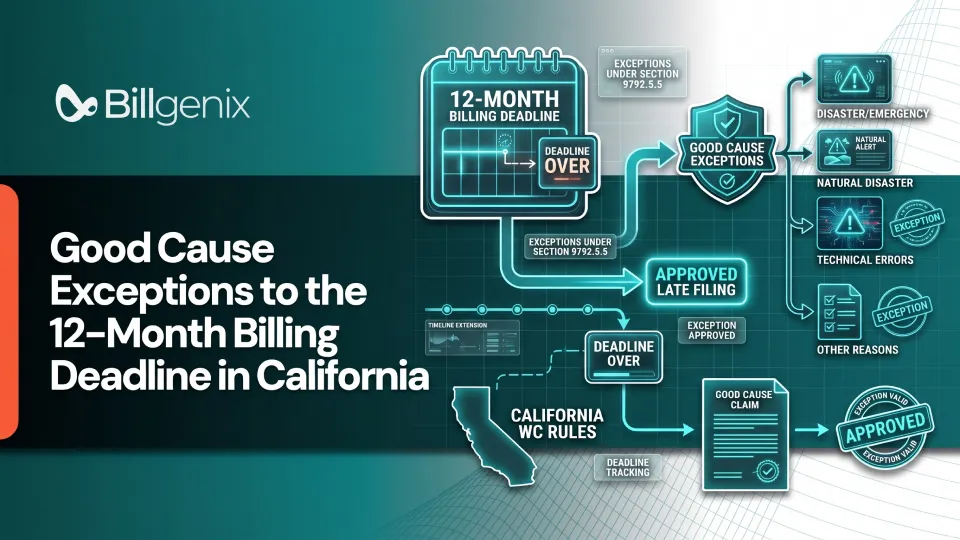
A California workers' comp good cause exception is a limited carve-out from the 12-month deadline for submitting medical bills. Labor Code 4603.2 says the Administrative Director must adopt rules defining good cause, and it specifically points to injuries or illnesses first treated as nonoccupational and later found compensable. What the statute does not do is promise that any late bill will be accepted. Whether a provider gets relief depends on the rules, the decisions and the facts of the case.
That gap matters. Under the California 12-month billing deadline, a bill that arrives late can be denied, and late workers' comp medical bills often turn into disputes that providers are not prepared for. Many billing teams assume a good reason for the delay is enough. It is not that simple.
This article walks through what the statute says, what is and is not clearly defined, how a later compensability finding fits in, and what your team should document if a bill goes out late. It is educational, not legal advice, and any real late bill should be reviewed by a California workers' compensation attorney or qualified specialist.
1What Is California's 12-Month Workers' Comp Billing Deadline?
The general rule under Labor Code 4603.2
For medical-treatment services provided on or after January 1, 2017, Labor Code 4603.2 requires the request for payment, with an itemization of services and the charge for each, to be submitted to the employer within 12 months. A request that is not timely submitted can be barred, subject to the applicable rules and exceptions.
How the date of service determines the deadline
For most outpatient and professional services, the clock starts on the date of service. A visit on March 10, 2026, for example, begins the 12-month period that day, whatever date the bill was later created or entered into a billing system.
The different starting point for inpatient facility services
For inpatient facility services, the 12 months run from the date of discharge, not the admission date. A hospital stay is measured from the day the patient leaves.
Why shorter deadlines may apply to some bill categories
The 12-month rule is the general rule, not a universal one. Some categories carry different statutory deadlines, such as the 30-day period for certain services exempt from prospective review and the 180-day period for emergency services in a general acute care hospital under Labor Code 4610(d). Confirm which rule applies before you rely on 12 months. Our article on California's 12-month billing deadline covers the general rule in more detail.
2What Does "Good Cause" Mean in the Statute?
The language in Labor Code 4603.2
The statute does two things in the same breath. It sets the 12-month period, and it tells the Administrative Director to adopt rules to carry that period out. Those rules are supposed to define circumstances that count as good cause for an exception, including provisions that address the situation where an injury or illness was first treated as nonoccupational and later determined to be compensable.
The statutory direction to define exceptions through rules
Notice the structure. The Legislature did not list exceptions in the statute. It handed the job of defining them to the Administrative Director. That means the practical content of a good-cause exception depends on what rules exist and how they are applied.
Why statutory wording does not automatically guarantee relief
It is tempting to read the good-cause language as a safety valve that any provider can use. A safer reading is that the statute acknowledges exceptions should exist, while leaving their definition to rulemaking. The legal effect of a late submission turns on the applicable law and the decisions interpreting it, not on a provider's own view that the delay was reasonable.
California Labor Code 4603.2 refers to good-cause exceptions to the 12-month billing deadline and specifically mentions injuries or illnesses later found to be compensable. Providers should not assume that this language alone guarantees acceptance of a late bill. The applicable regulations, current legal authorities and the facts of the case should be reviewed.
3Are Good-Cause Exceptions Clearly Defined in California?
What the statute directs the Administrative Director to do
The direction is clear: adopt rules to implement the 12-month limitation period, and in those rules define what constitutes good cause. What is less clear is how fully that direction has been carried out in the regulations.
The issue of implementing regulations
Providers and defendants have both pointed to the lack of detailed implementing rules for the good-cause language. When a statute tells an agency to write rules and the rules are thin or missing, parties end up arguing about what the statute alone requires. That is the situation behind much of the dispute over late medical bill submission California providers face.
How published WCAB decisions have discussed the issue
Published Workers' Compensation Appeals Board panel decisions have addressed the absence of implementing rules and the limits of relying on the statutory language alone. Decisions such as the 2022 Garcia decision and the March 2025 Cartagena decision discuss a 12-month bill submission dispute and the statutory exceptions issue.
Two cautions apply. First, each decision turns on its own record and legal questions, so no single case should be read as a universal outcome. Second, WCAB panel decisions are not binding in the way an en banc or appellate decision is, although the Board may find their reasoning persuasive. Read the decisions yourself, or have counsel read them, and check for anything more recent.
Why providers should not assume a late bill will be accepted
Given that uncertainty, the responsible position is simple. Do not plan around an exception. Treat the 12-month deadline as firm, and treat any exception as something you may have to argue, with evidence, if a bill ever goes late.
4Nonoccupational Injuries Later Found to Be Compensable
What happens when treatment initially appears nonoccupational
Sometimes a patient is treated as if the injury or illness is unrelated to work. The bill may go to a group health plan or to the patient, and no workers' compensation claim is on the table. Later, the condition is determined to be work related.
Why a later compensability determination may matter
By the time compensability is settled, much of the 12-month period may have passed. This is the exact circumstance the statute names as one the rules should address. It is a nonoccupational injury later found compensable, and it is the most obvious example of why a good-cause concept exists at all.
Naming a circumstance is not the same as guaranteeing a result. The statute does not say that a later finding automatically extends the deadline or guarantees payment of a late bill.
Which dates and records the provider should preserve
If this situation could apply to you, keep a clean record of the following:
- The date of service or inpatient discharge
- The date the claim was first treated as nonoccupational and by whom it was billed
- The date and form of the compensability determination
- The date your office learned of that determination
- The date the bill was then submitted to the correct claims administrator
Why the facts and current legal authority need review
Timing matters. How quickly your team acted after learning of the determination, which payer received the earlier bill, and what rules and decisions are current can all affect how a dispute plays out. This is a question for case-specific legal review.
5What Should Billing Teams Document When a Bill Is Late?
The records below are a practical evidence-preservation list. They are not a list of legally recognized exceptions, and collecting them does not establish eligibility for one. Strong documentation for late workers' comp bills simply gives everyone, including your attorney, something concrete to evaluate.
Date of service or inpatient discharge
Start with the dates that anchor the deadline, confirmed against the clinical record.
Original bill creation and submission dates
Show when the bill was created and when, if ever, it was first sent. Gaps between those dates are often the center of a dispute.
Clearinghouse and payer acknowledgments
These reports serve as proof of timely bill submission. A clearinghouse report or payer acknowledgment shows that a bill reached its destination and when.
Rejection notices and resubmission history
Keep every rejection and every correction. If an earlier version of the bill was filed on time and later rejected, that history needs to be traceable. Our guide to claim acknowledgment and rejection tracking explains how to follow those responses.
Records concerning compensability or claim status
Preserve letters, notices and portal records about whether the claim was accepted, denied or delayed, along with their dates.
Communications explaining the cause of the delay
Save emails, call notes and letters that show why the bill could not be submitted sooner. Stick to facts and dates rather than conclusions.
A quick late-bill checklist
Mark each item as collected. Completing the list does not establish legal eligibility for an exception.
- Record the date of service or inpatient discharge.
- Confirm which statutory filing deadline applies to the service.
- Locate the original bill and its itemized charges.
- Preserve clearinghouse reports, payer acknowledgments and delivery records.
- Collect rejection notices and the history of corrections or resubmissions.
- Preserve relevant communications about claim status or compensability.
- Write a factual timeline explaining when the delay occurred and why.
- Refer the matter for California workers' compensation legal review.
6What to Do When a Workers' Comp Bill May Be Past Due
Verify the correct statutory deadline
First confirm which time limit actually governs the bill. A bill you believe is late under the 12-month rule may be subject to a different provision, or a bill you think is on time may fall under a shorter one.
Confirm the correct payer or claims administrator
Make sure the bill went, or is going, to the right party. A bill sent to the wrong payer may not count the way you expect.
Review the submission and acknowledgment trail
Pull the full history. Sometimes the trail shows a timely submission that was rejected on a technical issue, which is a very different story from a bill that was never sent. Our article on electronic remittance advice and payment posting can help your team follow what happened after a bill was processed.
Submit or correct the bill promptly where appropriate
If the bill has not been submitted or needs correction, do not let it sit while you debate the legal question. Prompt action is part of a credible record.
Obtain California workers' compensation legal guidance
A late bill with real money at stake deserves review by an attorney or qualified specialist who can look at the current rules and the facts. Do not assume that sending an explanatory letter alone cures a late filing.
Keep written records of any decision and follow-up
Document who decided what, when, and why, and log every follow-up with the payer.
7How to Reduce Late-Billing Risk in Workers' Compensation
The best way to handle a good-cause question is to avoid ever needing to raise one. Solid workers' comp billing compliance starts with a few dependable habits, and our workers' comp billing deadlines and timelines article covers related timing rules.
Record service dates accurately
Enter the correct service date or discharge date from the start. Every deadline calculation depends on it.
Set internal submission targets ahead of statutory deadlines
Pick a target date well before the legal limit, so that a rejection or missing document does not push you over. This is the core of medical billing deadline tracking.
Review rejections and missing acknowledgments promptly
Look at response reports daily or weekly. A bill with no acknowledgment is a bill you cannot treat as submitted.
Escalate unresolved payer or claim-status issues
Set a rule for when a stuck bill moves to a supervisor, especially when a claim status question is blocking submission.
Retain evidence of bill delivery and follow-up
Keep submission records and follow-up notes in one place, tied to the bill. Your future self and your attorney, will thank you. For a broader view, see our California workers' compensation billing requirements guide.
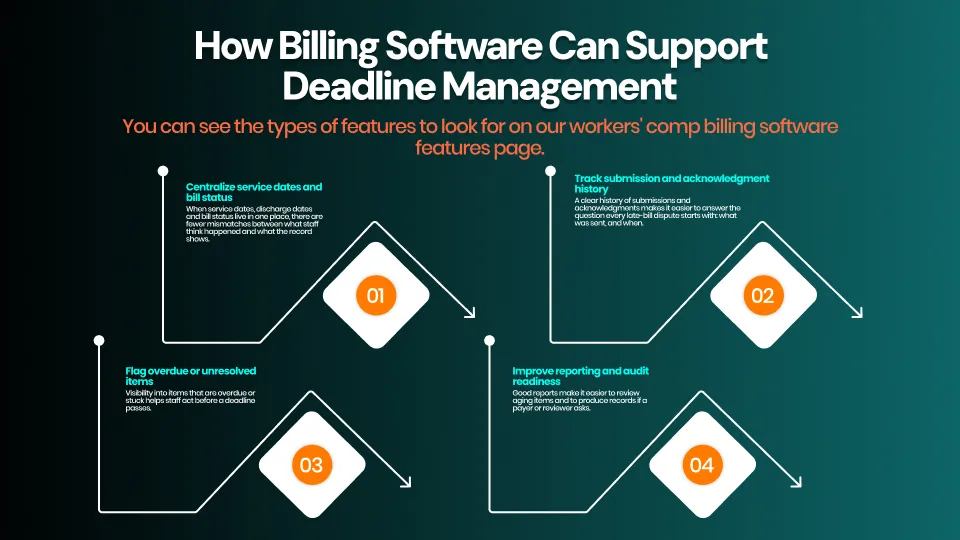
8Can Support Deadline Management
Spreadsheets and shared calendars work only up to a point. As volume grows, dedicated workers' comp billing software can help teams keep billing deadline management consistent. You can see the types of features to look for on our workers' comp billing software features page.
Centralize service dates and bill status
When service dates, discharge dates and bill status live in one place, there are fewer mismatches between what staff think happened and what the record shows.
Track submission and acknowledgment history
A clear history of submissions and acknowledgments makes it easier to answer the question every late-bill dispute starts with: what was sent, and when.
Flag overdue or unresolved items
Visibility into items that are overdue or stuck helps staff act before a deadline passes.
Improve reporting and audit readiness
Good reports make it easier to review aging items and to produce records if a payer or reviewer asks.
Software supports the process. It does not replace verifying the right deadline for each bill or getting legal advice on a disputed one.
9Frequently Asked Questions
What is a good-cause exception to California's 12-month billing deadline?
It is an exception that Labor Code 4603.2 says the Administrative Director's rules should define, allowing some bills submitted after 12 months to be considered. The statute mentions injuries or illnesses initially treated as nonoccupational and later found compensable, but the practical scope of any exception depends on the rules, decisions and facts.
Does Labor Code 4603.2 automatically allow late bills?
No. The statute sets the 12-month rule and refers to good-cause exceptions, but it does not guarantee acceptance of a late bill. Providers should review the applicable regulations, current legal authority and the specifics of the case.
What if an injury is initially considered nonoccupational but later found compensable?
The statute expressly mentions this circumstance as one the rules should address. That does not mean the deadline is automatically extended or that a late bill will be paid. Preserve the dates and records, act promptly and seek legal review.
What documentation should a provider keep for a late bill?
Keep the service or discharge date, the original bill, creation and submission dates, clearinghouse and payer acknowledgments, rejection and resubmission history, records about claim status or compensability and a factual timeline of the delay. These records help evaluate the situation but do not prove an exception applies.
Can a rejected bill be resubmitted after the deadline?
A corrected resubmission may be possible, but whether it is treated as timely can depend on the original submission history and the applicable rules. Keep the full trail of the original submission and rejection and have the matter reviewed if the deadline has passed.
Does the 12-month rule apply to every California workers' compensation bill?
No. It is the general rule for medical-treatment bills. Some categories, such as specified services exempt from prospective review and emergency services in a general acute care hospital, have shorter statutory deadlines, and other types of billing may follow different provisions.
Where can providers verify current California billing requirements?
Start with the text of Labor Code 4603.2 and the California DWC electronic billing FAQs. For case discussion, review published WCAB panel decisions, including Garcia (2022) and Cartagena (March 2025) and check for newer authority before relying on any of them.
10Improve Your Workers' Comp Billing Compliance with BillGenix
Most late-billing disputes are easier to prevent than to win. Organized submission records, prompt follow-up on rejections and acknowledgments and clear internal deadlines help billing teams reduce preventable delays and they leave a cleaner record if a question about timeliness ever arises.
Reduce Preventable Workers' Comp Billing Delays
Organize billing records, monitor submission status and keep follow-up workflows consistent. Explore how BillGenix can support your workers' compensation billing operations.

