
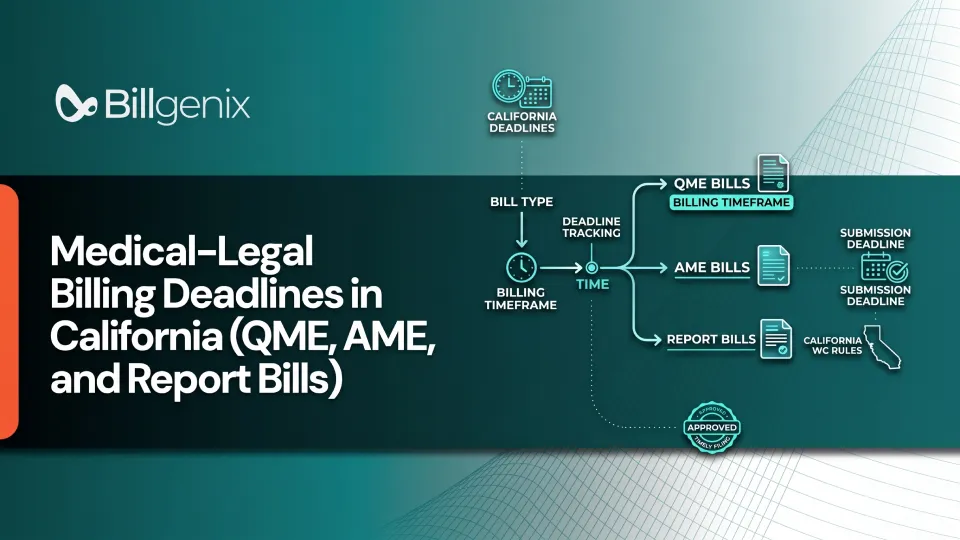
California medical-legal billing deadlines are not a single clock. There are three separate time frames to manage: the deadline to complete and serve a medical-legal report, the deadline to submit the bill for that report, and the period in which a claims administrator must pay or dispute the charge. Under Labor Code 4625, covered medical-legal bills for services provided on or after January 1, 2017, generally must be submitted within 12 months of the service date. Payment and disputes are handled under a different rule, Title 8, California Code of Regulations section 9794.
Mixing these up is a common and expensive mistake. A team that tracks only the report due date can miss the billing window, and a team that tracks only the billing window can lose sight of the payment clock that starts when the required reports and documents arrive.
This guide explains each deadline, who it applies to, and how billing teams working on medical-legal report billing for Qualified Medical Evaluators (QMEs), Agreed Medical Evaluators (AMEs) and other providers can keep them straight. It is educational, not legal advice, and deadline-sensitive cases should be reviewed by a qualified California workers' compensation professional.
1The main deadlines at a glance
Use this table as a starting point. These are general rules, and readers must check the current regulations and the specific circumstances of each case.
Deadline type | What it covers | What to track |
Report completion | Preparing and submitting the applicable QME or AME report | Examination date, report due date, extension request and approval |
Bill submission | Sending a covered medical-legal bill within the applicable period | Service date, submission date, delivery or receipt evidence |
Payment or dispute | Claims administrator response after receipt of required reports and documents | Date complete materials were received, payment status, Explanation of Review |
Supplemental report | Preparing a requested supplemental report | Request date, records supplied, due date, agreed extension if applicable |
2What Is Medical-Legal Billing in California Workers' Compensation?
What are QME and AME evaluations?
A Qualified Medical Evaluator (QME) is a physician certified by the Division of Workers' Compensation (DWC) to evaluate injured workers when there is a dispute, often about the nature or extent of an injury or disability. An Agreed Medical Evaluator (AME) is a physician the parties agree on, usually in a represented case, to perform that evaluation. Both produce reports that can influence how a claim is decided.
What is a medical-legal report?
A medical-legal report is a report prepared to help resolve a dispute, rather than to treat the patient. Comprehensive evaluations, follow-up evaluations and supplemental reports are the main categories. The expenses connected to producing them are called medical-legal expenses.
How medical-legal billing differs from treatment billing
Treatment billing covers care provided to the patient. Medical-legal billing covers evaluations and reports tied to a dispute. They follow different rules, different deadlines and, in important ways, different fee schedules. The California medical-legal fee schedule governs comprehensive, follow-up and supplemental evaluations, while other treating or consulting physician reports may fall under the Official Medical Fee Schedule instead. Always confirm the service category before you bill.
3California's 12-Month Medical-Legal Billing Deadline
What California Labor Code 4625 requires
The 12-month medical-legal billing deadline comes from Labor Code 4625. For covered medical-legal services provided on or after January 1, 2017, the bill generally must be submitted within 12 months of the service date. This is a bill submission rule. It says nothing about how quickly the report itself must be finished.
When the 12-month period begins
The period is measured from the service date, not from the date the report was signed, the date the invoice was created, or the date the claim closed. Record the correct service date at the outset, because every later calculation depends on it.
Which bills may fall within the rule
The rule applies to covered medical-legal services. Do not assume it fits every bill from a physician. A treating physician's progress report, for example, is a different category from a QME comprehensive evaluation. Verify what kind of service you are billing and which statute governs it.
What to do if a bill may be late
The statute includes a provision for good-cause exceptions, but it should be read carefully. It does not promise that a late bill will be accepted, and a delay alone does not create an exception. If a deadline may have passed, act quickly: gather the dates and records, confirm which rule applies, submit or correct the bill where appropriate, and have a qualified California workers' compensation professional review the situation. Our article on good-cause exceptions to the billing deadline explains the uncertainty in more detail, and our overview of the 12-month workers' compensation billing window covers the general treatment-billing rule.
4QME and AME Report Preparation Deadlines
Report deadlines are a separate matter from billing deadlines. The QME report submission deadline concerns the evaluator's obligation to complete and serve the report, not the provider's obligation to submit a bill.
The general 30-day initial or follow-up report time frame
Under 8 CCR section 38 an initial or follow-up comprehensive report is generally prepared and submitted within 30 days after the QME, Agreed Panel QME or AME sees the employee or otherwise commences the evaluation procedure, subject to the applicable extension rules.
When a time extension may be requested
The regulation allows extensions in certain circumstances, and only as the regulation permits. Do not treat an extension as automatic. Keep a written record of any request and the response.
QME Form 112 and extension procedures
QME extension requests are handled through the procedures described in the DWC's rules and forms, including QME Form 112. Review the current form and instructions directly from DWC before relying on them, since procedures can change.
Supplemental report deadlines
A supplemental report is generally due within 60 days after the written or electronic request, subject to the regulation's terms and any permitted extension. Track the request date, the records supplied and the due date separately from any billing dates.
Remember that a report that is completed on time can still be billed late, and a bill that is submitted promptly can still be delayed if the report was not finished. The two clocks run independently.
5The 60-Day Medical-Legal Payment and Dispute Period
When the payment clock starts
The 60-day medical-legal bill payment period under 8 CCR section 9794(b) generally runs from the date the employer receives the required reports and documents, unless liability is contested within that period. It is not tied simply to the examination date or to the day a billing team creates an invoice.
Why required reports and documents matter
Because the clock depends on receipt of the required materials, an incomplete bill package can delay the start of the period. A bill that arrives without the report or other required documents may not trigger the payment clock the way you expect. Our guide to proof of timely billing submission and receipt explains how to document what was sent and what was received.
How a claims administrator may dispute a bill
A claims administrator may object to a bill or contest liability within the applicable period. When that happens, the provider should read the stated reason carefully, preserve all correspondence and follow the applicable second-review or dispute process under the regulation.
What an Explanation of Review should identify
An Explanation of Review (EOR) is the written response a payer issues to explain how it handled a bill, including any reduction, denial or request for more information. A useful EOR identifies the bill, the amounts allowed or denied and the reasons. If it does not give a clear reason, ask for clarification in writing. For help matching payments to bills, see our article on electronic remittance advice and payment reconciliation.
6QME, AME, and Other Medical Report Bills: What Is Different?
Not every report from a physician is a medical-legal evaluation report. The regulation separates specified medical-legal evaluations from other reports, and getting the category wrong can affect both the deadline and the amount.
Comprehensive, follow-up, and supplemental evaluation bills
These are the core medical-legal evaluation categories, and each has its own fee-schedule treatment under 8 CCR section 9795. Confirm which category your service falls into.
Medical-legal diagnostic testing and supporting documentation
Diagnostic testing connected to a medical-legal evaluation and the documentation that supports it may have their own billing requirements. Check the regulation and current DWC guidance rather than assuming treatment-billing rules apply.
Treating or consulting physician reports
Reports prepared by a treating physician or consulting physician in the course of care are not automatically medical-legal evaluation reports. They may fall under the Official Medical Fee Schedule instead of the medical-legal fee schedule.
Choosing the applicable fee schedule
The fee schedule follows the service category. When in doubt, review the regulation or ask a qualified specialist before you bill.
7How to Submit a Complete Medical-Legal Bill
Verify the bill and service category
Confirm whether you are billing a comprehensive, follow-up or supplemental evaluation, or something else entirely. This decides which rules apply.
Include the required report and documents
Send the required report and supporting documents with the bill. Missing materials are one of the most common reasons for delay and can affect when the payment period begins.
Check the fee schedule and applicable coding
Review the applicable fee-schedule rules and make sure the coding matches the service. A mismatch can trigger a reduction or dispute.
Submit using the applicable paper process
Pay attention here. According to California DWC's e-billing FAQ, electronic billing applies to medical treatment bills, not medical-legal bills, and medical-legal bills should be submitted on paper. Confirm the current DWC instructions before you set up your process, and do not assume routine electronic submission is an accepted default for medical-legal bills.
Retain proof of submission and receipt
Because paper submission leaves a thinner automatic record, keep mailing receipts, tracking information, delivery confirmation and a copy of everything you sent. Proof of mailing shows that something was sent. Delivery or receipt evidence shows that it arrived.
8Common Medical-Legal Billing Errors That Cause Delays
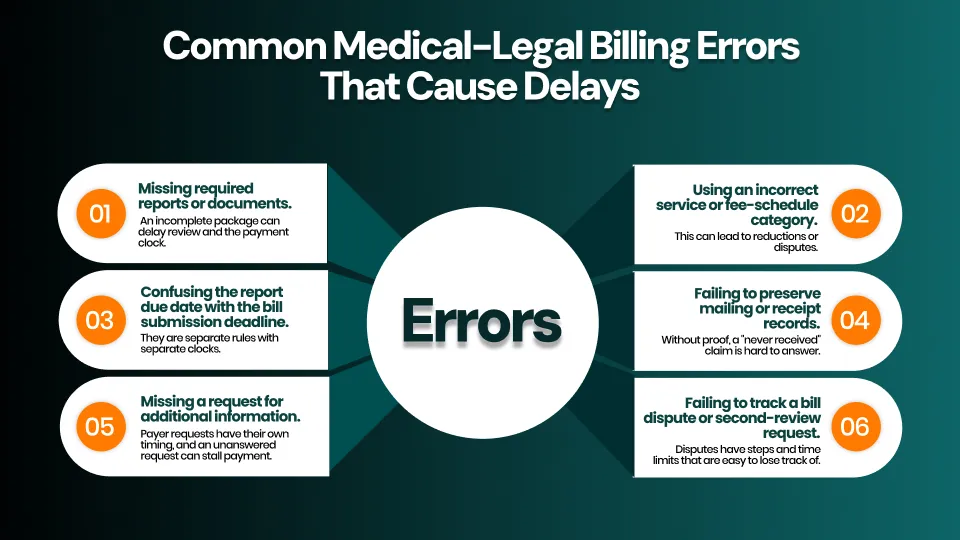
- Missing required reports or documents. An incomplete package can delay review and the payment clock.
- Using an incorrect service or fee-schedule category. This can lead to reductions or disputes.
- Confusing the report due date with the bill submission deadline. They are separate rules with separate clocks.
- Failing to preserve mailing or receipt records. Without proof, a "never received" claim is hard to answer.
- Missing a request for additional information. Payer requests have their own timing, and an unanswered request can stall payment.
- Failing to track a bill dispute or second-review request. Disputes have steps and time limits that are easy to lose track of.
9How to Build a Medical-Legal Billing Deadline Workflow
Strong medical-legal billing compliance comes from process, not memory. A simple workflow that separates each clock will prevent most of the problems above.
Track examination, report, and billing dates separately
Give every case its own record with the examination date, the report due date, any extension, the billing deadline and the payment follow-up date. Do not collapse them into a single "due date."
Create deadline alerts and exception queues
Whether you use a spreadsheet, calendar reminders or a dedicated system, set internal targets ahead of each legal deadline and keep a queue for items that need attention, such as bills with missing documents or disputes awaiting a response.
Keep reports, invoices, and receipt evidence together
Store the report, the invoice, mailing or delivery records and all correspondence under the same case reference. When a payer asks questions, you want one place to look.
Monitor disputes, corrections, and outstanding payments
Review open items on a regular schedule. Follow up on bills that have passed their expected payment date, and track second-review requests through to resolution.
Good software can support this kind of process. Dedicated workers' compensation billing software can help teams organize records, see what is outstanding and keep follow-up consistent, though it does not replace confirming the right rule for each bill. For broader background, see our guide to California workers' compensation billing and our article on California workers' compensation billing deadlines.
10Frequently Asked Questions
What is the deadline to submit a QME bill in California?
The QME billing deadline for covered medical-legal services provided on or after January 1, 2017, is generally 12 months from the service date under Labor Code 4625. This is separate from the report deadline and the payment period. Confirm the rule that applies to your specific service before relying on it.
Does the same medical-legal billing deadline apply to AME bills?
The AME billing deadline follows the same general medical-legal rule in Labor Code 4625 for covered services, but each bill depends on its service category and facts. Report deadlines and payment timing are separate, so verify the applicable regulation and consult a qualified California workers' compensation professional for case-specific questions.
Is the report deadline the same as the bill submission deadline?
No. Report deadlines, such as the general 30-day time frame for comprehensive reports and the 60-day time frame for supplemental reports under 8 CCR section 38, govern preparing and serving the report. The bill submission deadline governs when the bill must be sent. Track them as two separate clocks.
When does the 60-day medical-legal payment period begin?
The 60-day payment period under 8 CCR section 9794(b) generally begins when the employer receives the required reports and documents, not on the examination date or the invoice date. Liability may be contested within that period. Keep proof of what was sent and when it was received.
Can medical-legal bills be submitted electronically in California?
According to California DWC's e-billing FAQ, electronic billing applies to medical treatment bills, not medical-legal bills, which should be submitted on paper. Instructions can change, so confirm the current DWC guidance before building a process and do not assume electronic submission is acceptable.
What happens if a medical-legal bill is submitted late?
A late bill may be denied or disputed, and the statute's good-cause provision does not guarantee relief. Preserve all records, confirm the applicable deadline, submit or correct the bill where appropriate, and seek review from a qualified California workers' compensation professional as soon as possible.
Do all physician reports use the medical-legal fee schedule?
No. The medical-legal fee schedule applies to specified medical-legal evaluations such as comprehensive, follow-up and supplemental evaluations. Reports from treating or consulting physicians may fall under the Official Medical Fee Schedule instead. Confirm the service category and the current regulation before you bill.
11Improve Your California Medical-Legal Billing Workflow
The goal is to know which clock applies to each task. Standardize how your team tracks examination and report dates, checks required documents, records submission and receipt, and follows up on disputes. Doing this consistently helps prevent avoidable deadline problems and payment disputes.
Keep Medical-Legal Billing Deadlines Under Control
Simplify your workers' compensation billing workflow with consistent deadline tracking, organized documentation, and a clear process for following up on outstanding bills. Explore whether BillGenix fits your medical-legal billing operations.

