
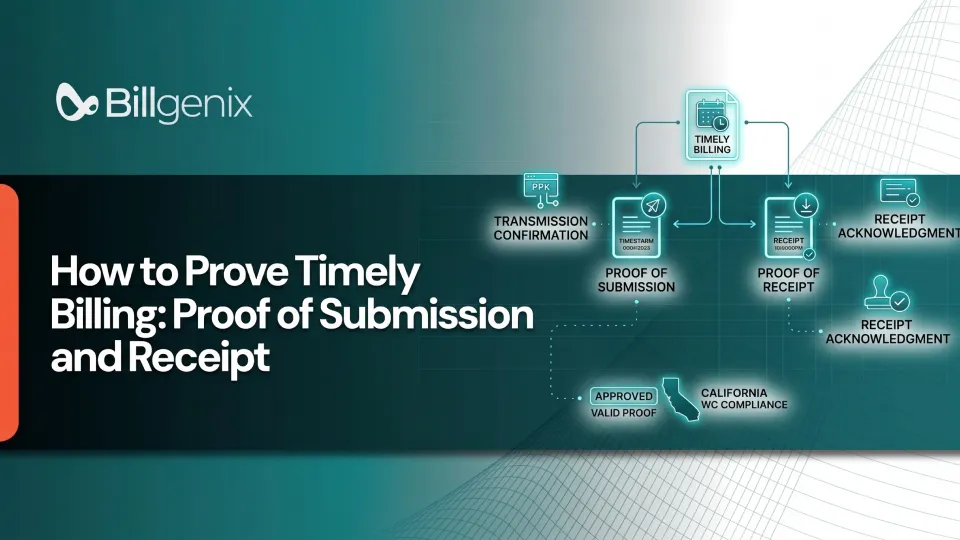
Proof of timely billing is a documented record showing that a medical bill was sent within the required deadline, that the payer received it, and what happened afterward. In California workers' compensation no single record does all of that. A transmission log, a payer acknowledgment and confirmation that a bill was complete each prove something different and billing teams need all of them when a payer says a bill never arrived.
Disputed submission dates are one of the most frustrating problems in workers' comp billing. A bill is sent, weeks pass and the payer says it has no record. If your team cannot show what was sent, when and what came back, the deadline can become a reimbursement problem.
Strong documentation combines four things: the exact bill that was submitted, evidence of transmission, acknowledgment records and the follow-up history. This guide explains what each record can and cannot show, how to build a complete evidence trail and what to do when receipt cannot be confirmed.
1Why Proof of Timely Billing Matters in California Workers' Compensation
Understanding the difference between a service date and a submission date
The service date is when care was provided. The submission date is when the bill was sent. Deadlines are generally measured from the first and met by the second, so your records need to be captured both accurately and separately.
How billing deadline disputes can affect reimbursement
California Labor Code 4603.2 establishes a 12-month submission period for covered medical-treatment services provided on or after January 1, 2017, with inpatient facility bills measured from discharge. Other bills may be subject to different deadlines, so verify the rule for each bill type. You can read more in our guide to California's 12-month billing window and our overview of workers' compensation billing deadlines.
When workers' compensation billing deadlines are in question, the party who can produce clear records is in the stronger position. A provider with no evidence has only an assertion. If a bill goes late for reasons outside your control, our article on good-cause exceptions to the billing deadline explains why even that situation depends on documentation and legal review.
Why internal timestamps alone may be insufficient
A "sent" status in your own system shows that your software did something. It does not show that a file left your network, reached the payer, or was accepted. Internal timestamps are a starting point, not a finish line.
2What Counts as Proof of Bill Submission?
Proof of bill submission is any record that shows what you sent, when you sent it, and how. Each type has strengths and limits.
Electronic billing system submission logs
A submission log shows when your system generated and released a bill. It is useful for tracing your own workflow, but it generally cannot prove delivery to the payer.
Clearinghouse transmission reports
A clearinghouse report can show that a file was received from you and passed along. It is stronger evidence than an internal log, but it may not establish when the payer itself received the bill.
Payer portal confirmation numbers
If a payer portal gives you a confirmation number or receipt page after upload, save it right away, with a screenshot or download that shows the date, time and reference.
Paper billing records and mailing documentation
For paper bills, keep the mailing receipt, tracking information and a copy of the cover page. Proof of mailing shows that you sent something. It is not the same as proof of delivery or receipt, so use delivery confirmation or signature options where available.
Copies of the submitted bill and supporting documents
Keep the exact version that went out, with all attachments. If a payer says a bill was incomplete, you need to show what the complete package looked like on the day it was sent.
3How to Prove the Payer Received a Medical Bill
Proof of receipt medical billing teams can rely on comes from the payer side of the transaction, not from your own system.
Save payer-generated receipt confirmations
Any confirmation created by the payer or its agent carries more weight than something you produced yourself. Store it with the bill record.
Review electronic acknowledgments and claim-level responses
Electronic responses tell you whether files and individual bills were accepted for processing. Review them on a regular schedule instead of assuming silence means success.
Match acknowledgments to the correct bill and claim
An acknowledgment is only useful if it clearly points to a specific bill. Match each response to the right bill, claim reference and submission attempt.
Record payer portal status changes
If the payer portal shows statuses such as received or in review, capture the status with a date and time. Portal pages change, and an unsaved status is easily lost.
Wherever possible, evidence should identify the destination, the date and time, the bill or claim reference, and the response status.
Evidence comparison at a glance
Different records answer different questions. The table below shows what each type of evidence generally supports. It is a general guide and the precise meaning of any record depends on its content and the workflow involved.
Type of evidence | What it generally shows | What it does not necessarily show |
Submission evidence (system log, clearinghouse report) | A bill or file was sent, and roughly when | That the payer received it or when |
Receipt evidence (payer confirmation, portal receipt) | The payer or its agent received something | That every claim in it was complete or accepted |
Claim-level acceptance (claim acknowledgment, accepted status) | A specific bill passed initial checks or was rejected | That the bill will be paid |
Payment and adjudication status (remittance, explanation of review) | The bill was reviewed and how it was decided | That earlier submission steps met every legal requirement |
4Understanding EDI Evidence: TA1, 999, and 277CA
Most California electronic billing runs on Electronic Data Interchange (EDI), a standard way of exchanging billing transactions between systems. California's Division of Workers' Compensation publishes its own electronic billing requirements, including a Medical Billing and Payment Guide and Companion Guide, so always confirm the details against those official resources.
A good EDI acknowledgment in medical billing shows how far a transaction traveled and what happened to it. Each type of response sits at a different point in the process.
TA1 interchange acknowledgment
A TA1 responds to the outer envelope of a transmission. It generally tells you whether the interchange was readable and correctly formed. It says little about individual bills.
999 implementation acknowledgment
The 999 acknowledgment meaning is often misunderstood. A 999 reports whether a file met the technical syntax rules, so it tells you whether the file was accepted or rejected at that level. It is not a statement that every claim inside was accepted for adjudication. X12, the standards organization behind these transactions, specifically cautions that a 999 does not necessarily establish the date a carrier received the claim transaction. Our article on understanding the 999 acknowledgment goes deeper.
277CA health care claim acknowledgment
The 277CA claim acknowledgment is a claim-level response. Where it applies, it reports on individual bills, such as whether they were accepted or rejected for further processing. It is more specific than a 999, but the meaning still depends on the response content and the trading-partner workflow. See our guide to tracking claim acknowledgments for how to read these responses.
Why an accepted file is not the same as a paid claim
An accepted file means the data was readable. An accepted claim means it passed initial checks. Payment is a separate decision, reported later through a remittance. For that last step, see our explanation of electronic remittance advice. Never describe any acknowledgment as definitive proof that a particular bill was accepted for payment.
5How to Build a Complete Billing Evidence Trail
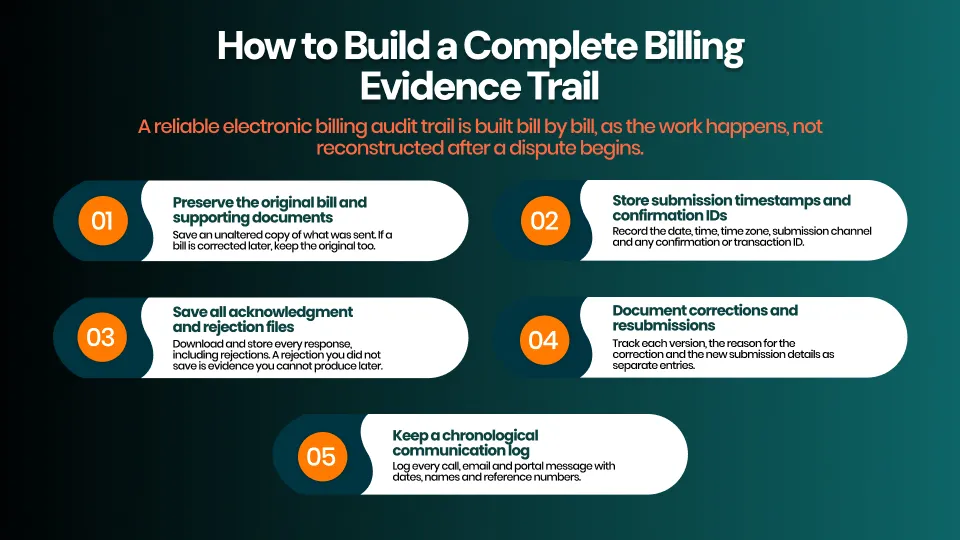
A reliable electronic billing audit trail is built bill by bill, as the work happens, not reconstructed after a dispute begins.
Preserve the original bill and supporting documents
Save an unaltered copy of what was sent. If a bill is corrected later, keep the original too.
Store submission timestamps and confirmation IDs
Record the date, time, time zone, submission channel and any confirmation or transaction ID.
Save all acknowledgment and rejection files
Download and store every response, including rejections. A rejection you did not save is evidence you cannot produce later.
Document corrections and resubmissions
Track each version, the reason for the correction and the new submission details as separate entries.
Keep a chronological communication log
Log every call, email and portal message with dates, names and reference numbers.
Link every record to the same internal bill ID, patient or claim reference, payer, service date and submission attempt. Handle protected health information according to your organization's privacy and security policies.
A practical evidence checklist
Use this list for every bill. Completing it does not guarantee a favorable outcome, but it gives you what a reviewer will want to see.
- Original bill and supporting documents: Retain the exact version sent and its attachments.
- Submission timestamp: Record date, time, time zone, submission channel and sending system.
- Transmission or portal confirmation: Save the transaction ID, confirmation number or delivery record.
- Payer acknowledgment: Store TA1, 999, 277CA or other applicable response files.
- Claim-level status: Determine whether the specific bill was accepted, rejected or marked incomplete.
- Correction and resubmission history: Keep each version, the reason for correction and the new submission timestamp.
- Follow-up communications: Record contact dates, case numbers and written payer responses.
6What to Do When a Payer Says a Bill Was Not Received
Verify the original transmission status
Start with your own records. Confirm what was sent, when, and through which channel.
Check for rejected files or missing acknowledgments
Look for any rejection that was never addressed, and for any bill with no acknowledgment at all. Many "never received" disputes trace back to a rejected file nobody noticed.
Contact the clearinghouse or payer using documented channels
Use channels that leave a record, such as email or a portal message, and note the date, the person and the reference.
Request written confirmation or an investigation reference
Ask the payer or clearinghouse for written confirmation of what they have on file, or an investigation reference number you can cite later.
Determine whether a corrected submission is needed
If the bill was rejected or incomplete, correct it and submit it promptly. Do not assume that sending a bill again automatically preserves the original submission date. Keep the original evidence, and record each correction or resubmission separately. If the dispute is deadline sensitive, escalate it quickly and consider legal guidance.
7Common Mistakes That Weaken Proof of Timely Billing
These habits make an otherwise solid process fall apart under scrutiny.
- Relying only on a "sent" status. It shows your system acted, not that the payer received anything.
- Failing to download acknowledgments. Responses that are not saved cannot support you later.
- Confusing file acceptance with claim acceptance. A technical acknowledgment is not a claim decision.
- Overwriting the original submission record after correction. Keep every version.
- Failing to track missing or rejected responses. Silence needs follow-up.
- Using inconsistent dates or time zones in reports. Mixed formats create confusion in a dispute.
- Keeping records without a clear bill or claim reference. An unlinked record proves little.
8How Billing Software Can Improve Submission Tracking
Spreadsheets and shared folders strain as volume grows. When evaluating tools, look at how well they support medical bill submission tracking and recordkeeping. The points below are capabilities to evaluate, not claims about any particular product.
Centralized submission history
One place for every submission attempt, with timestamps and references, makes it far easier to answer "what was sent, and when."
Acknowledgment and rejection monitoring
A system that surfaces rejected or unacknowledged submissions helps staff follow up before a deadline is at risk.
Deadline alerts and exception queues
Alerts and queues for items nearing their deadlines or stuck in an error state can keep problems from going unnoticed.
Bill-level audit trails and reporting
Reports tied to individual bills support internal reviews and give you ready records if a payer asks questions. For related background, see our California workers' compensation billing guide.
9Frequently Asked Questions
What is considered proof of timely billing?
Proof of timely billing is a set of records showing the exact bill sent, when and how it was transmitted, what the payer acknowledged, and what follow-up occurred. No single record is enough on its own. Together they create an audit trail that can be checked against the applicable deadline.
Does a clearinghouse report prove the payer received a bill?
Not necessarily. A clearinghouse report shows that a file passed through the clearinghouse and may show when it was forwarded. It may not establish when the payer itself received the bill. Pair it with payer acknowledgments, portal confirmations or written confirmation to build stronger proof of receipt.
Does a 999 acknowledgment prove a claim was accepted?
No. A 999 reports on whether a file met technical requirements, not whether each claim was accepted for adjudication. X12 cautions that it does not necessarily establish the date the carrier received the claim transaction. Look for claim-level responses and confirm requirements against California DWC guidance.
What should I do if I never receive a billing acknowledgment?
Treat a missing acknowledgment as an open issue. Check for rejected files, review your clearinghouse reports, and contact the clearinghouse or payer through a documented channel. Ask for written confirmation of what they have on file, and resubmit a corrected bill promptly if one is needed.
How should I document a corrected or resubmitted bill?
Keep the original bill and its evidence, then create a separate record for each correction. Note the reason for the change, the new submission timestamp, the confirmation or transaction ID and any new acknowledgments. Do not overwrite the earlier record, and do not assume a resubmission keeps the original date.
How long should workers' compensation billing records be retained?
Retention periods depend on legal, regulatory, payer and organizational requirements, so there is no single answer. Confirm the current requirements with California DWC resources, your compliance team or a qualified workers' compensation professional, and set a written retention policy that your team follows consistently.
10Improve Your Workers' Compensation Billing Workflow
The goal is simple: when someone asks whether a bill was sent on time, your team can answer with records instead of recollections. Take a fresh look at how your process handles submission tracking, acknowledgment follow-up, deadline monitoring and audit-ready documentation, and close the gaps before a dispute exposes them.
Keep Every Workers' Comp Bill Traceable
Build a more consistent billing process with clear submission records, acknowledgment follow-up, and organized claim documentation. Explore how BillGenix may support your workers' compensation billing workflow.

