

Understanding how to calculate OMFS reimbursement is essential for healthcare providers, medical coders, and revenue cycle teams treating injured workers in California. Under the state's workers' compensation system, payouts do not rely on a provider's billed charges. Instead, reimbursement depends on procedure codes, geographic multipliers, relative resource weights, and statutory conversion rates. Knowing how these variables interact helps billing teams forecast revenue, audit explanation of review (EOR) payments, and catch underpayments early.
1What Is OMFS Reimbursement?
The Official Medical Fee Schedule (OMFS) is the regulatory payment benchmark established by the California Division of Workers' Compensation (DWC) under California Code of Regulations Title 8, Section 9789.12.2. Rather than paying a percentage of billed charges, the OMFS sets an OMFS maximum reasonable fee for medical services.
Billed amounts reflect a clinic's standard retail fees, whereas allowable reimbursement represents the statutory ceiling under California DWC reimbursement rules. Because the OMFS divides care into distinct categories, such as physician, anesthesia, inpatient hospital, and ambulance services, billing staff must identify the correct service category before applying any pricing methodology.
2What Information Do You Need Before Calculating OMFS Reimbursement?
Before running a California workers' comp reimbursement calculation, gather seven data points from the claim and the official medical billing fee schedule:
- Applicable CPT or Procedure Code: The exact service code billed.
- Date of Service: Dictates which governing DWC schedule version applies.
- Facility or Non-Facility Setting: The Place of Service (POS) code indicating a private office or hospital setting.
- Applicable RVUs: The procedure's work, practice expense, and malpractice unit weights.
- Geographic Practice Cost Index Values: The county locality multipliers where care occurred.
- Correct Conversion Factor: The statutory dollar multiplier active on the service date.
- Applicable Modifiers and Ground Rules: Coding modifiers or edits that modify the base allowance.
Pulling values from date-specific DWC files prevents miscalculations caused by quarterly or annual updates.
3What Is the California OMFS Reimbursement Formula?
For non-anesthesia physician and non-physician practitioner services, the California OMFS reimbursement formula follows the Resource-Based Relative Value Scale (RBRVS) in Regulation 9789.12.2:
Base Maximum Fee = [(Work RVU × Work GPCI) + (Practice Expense RVU × Practice Expense GPCI) + (Malpractice RVU × Malpractice GPCI)] × Conversion Factor (CF)
Each variable in this OMFS physician fee calculation serves a distinct purpose:
- Relative Value Units (RVUs): Work RVU measures physician time and clinical effort; Practice Expense RVU covers clinic overhead and supplies; and Malpractice RVU reflects liability insurance costs.
- Geographic Practice Cost Index (GPCI): Adjusts each RVU component locally by California county.
- Conversion Factor (CF): Converts total geographically adjusted RVUs into dollars.
Crucially, facility fee calculation and non-facility fee calculation models use different Practice Expense RVUs, while anesthesia and other OMFS categories use separate pricing formulas.
4How to Calculate OMFS Reimbursement Step by Step
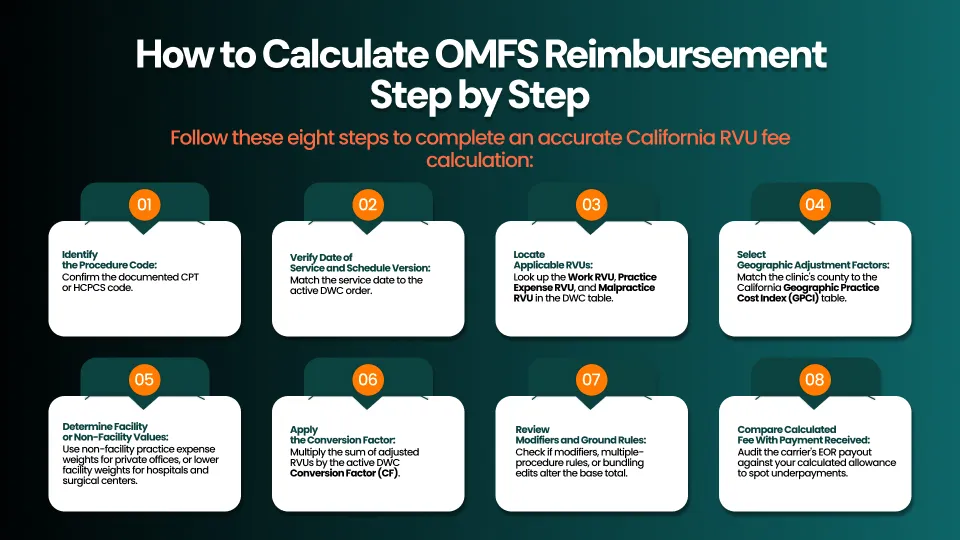
Follow these eight steps to complete an accurate California RVU fee calculation:
- Identify the Procedure Code: Confirm the documented CPT or HCPCS code.
- Verify Date of Service and Schedule Version: Match the service date to the active DWC order.
- Locate Applicable RVUs: Look up the Work RVU, Practice Expense RVU, and Malpractice RVU in the DWC table.
- Select Geographic Adjustment Factors: Match the clinic's county to the California Geographic Practice Cost Index (GPCI) table.
- Determine Facility or Non-Facility Values: Use non-facility practice expense weights for private offices, or lower facility weights for hospitals and surgical centers.
- Apply the Conversion Factor: Multiply the sum of adjusted RVUs by the active DWC Conversion Factor (CF).
- Review Modifiers and Ground Rules: Check if modifiers, multiple-procedure rules, or bundling edits alter the base total.
- Compare Calculated Fee With Payment Received: Audit the carrier's EOR payout against your calculated allowance to spot underpayments.
5OMFS Reimbursement Calculation Example
Review this simplified OMFS reimbursement example. The figures below are purely hypothetical mathematical illustrations, not actual California OMFS rates or verified code values.
Component | Illustrative Value |
Work RVU | 1.00 |
Work GPCI | 1.00 |
Practice Expense RVU | 0.50 |
Practice Expense GPCI | 1.00 |
Malpractice RVU | 0.10 |
Malpractice GPCI | 1.00 |
Conversion Factor | $40.00 |
Applying the standard physician formula:
- Work Component: 1.00 × 1.00 = 1.00
- Practice Expense Component: 0.50 × 1.00 = 0.50
- Malpractice Component: 0.10 × 1.00 = 0.10
- Total Adjusted RVUs: 1.00 + 0.50 + 0.10 = 1.60
- Base Maximum Fee: 1.60 × $40.00 = $64.00
In live California medical billing reimbursement, always substitute these placeholder numbers with official DWC tables matching the exact service date, locality, and facility setting.
6Why Can the Final Payment Differ From the Calculated Amount?
The base maximum fee represents the starting ceiling for an unadjusted procedure, but final payouts often differ due to regulatory payment rules. Modifiers, such as professional component modifier 26 or bilateral modifier 50, directly adjust allowable percentages. Multiple-procedure payment reductions (MPPR) also lower reimbursement when several procedures occur in one session.
Claims administrators additionally enforce National Correct Coding Initiative (NCCI) bundling edits, Medically Unlikely Edits (MUEs) and DWC ground rules. Incomplete clinical documentation or incorrect Place of Service coding can further reduce final payment.
7Common OMFS Calculation Errors to Avoid
Small lookup mistakes quickly distort fee schedule math. Avoid these common errors:
- Using Outdated RVUs: Relying on prior-year or expired quarterly RVU tables.
- Applying Wrong Conversion Factors: Mixing up general physician multipliers with anesthesia or outdated rates.
- Selecting Wrong Localities: Billing under a corporate headquarters zip code instead of the rendering clinic's county.
- Misclassifying Facility Status: Applying higher non-facility practice expense values to hospital services.
- Ignoring Modifiers and Edits: Overlooking NCCI edits or applying the physician formula to unrelated OMFS categories.
8Frequently Asked Questions
1. What is the formula for calculating California OMFS reimbursement?
For non-anesthesia physician services, the formula is: [(Work RVU × Work GPCI) + (Practice Expense RVU × Practice Expense GPCI) + (Malpractice RVU × Malpractice GPCI)] × Conversion Factor = Base Maximum Fee.
2. What are RVUs and how do they affect reimbursement?
Relative Value Units (RVUs) measure physician work, practice overhead and malpractice costs. Higher RVU weights increase the base reimbursement calculation.
3. What is the difference between facility and non-facility fees?
Non-facility fees apply to private offices and include higher practice expense RVUs for clinic overhead. Facility fees apply in hospitals or surgical centers and reimburse lower practice expenses because the facility covers overhead.
4. Does every California OMFS category use the same formula?
No. Physician and non-physician practitioner services use the RBRVS formula, whereas anesthesia, hospital and ambulance schedules follow separate methodologies.
5. Why might the final payment be lower than the calculated maximum fee?
Modifiers, multiple-procedure reductions, NCCI bundling edits, incorrect place-of-service coding, or incomplete documentation can reduce final payouts.
9Conclusion
Mastering RVU weights, local GPCI adjustments and active conversion factors empowers billing teams to verify workers' compensation payouts accurately. Keeping DWC fee tables current and auditing EOR statements prevents silent underpayments. To eliminate manual calculation errors and recover underpaid claims, partner with Billgenix for dedicated Workers' Compensation Billing Services, Medical Billing Services, Denial Management Services and Revenue Cycle Management Services.

