
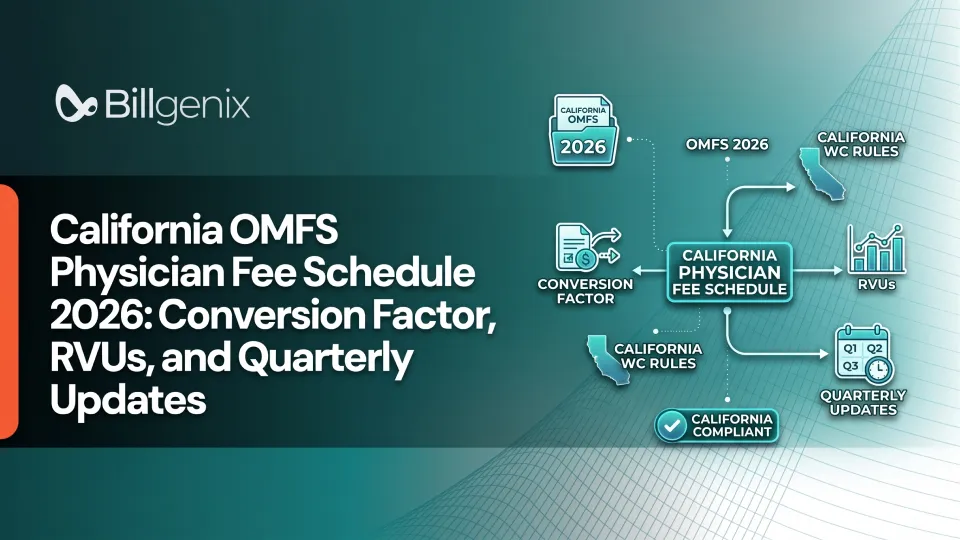
The California OMFS Physician Fee Schedule 2026 sets the maximum allowable reimbursement rates for medical services provided to injured workers across the state. Administered by the Division of Workers' Compensation (DWC), this schedule relies on Relative Value Units (RVUs), geographic cost adjustments and an updated Conversion Factor (CF) to determine exact payout amounts.
Because the DWC issues multiple regulatory adjustments throughout the calendar year, medical billing teams must verify the exact fee schedule file corresponding to each specific date of service. Using outdated rate tables or misapplying locality multipliers leads directly to underpayments, avoidable claim rejections and delayed revenue cycle collections.
1What Is the California OMFS Physician Fee Schedule?
The California workers' comp physician fee schedule is the regulatory pricing benchmark governing professional medical services within the state's workers' compensation system. Managed by the DWC under California Code of Regulations Title 8, Section 9789.12.2, the schedule aligns closely with the federal Medicare Physician Fee Schedule while incorporating California-specific statutory rules and multipliers.
The schedule covers a broad spectrum of clinical care, including services delivered by physicians, surgeons and non-physician practitioners such as nurse practitioners, physician assistants and physical therapists. Because reimbursement rates shift when the DWC adopts federal updates or state inflation adjustments, the date of service dictates which fee schedule version legally applies to a claim.
2What Are RVUs in the California Physician Fee Schedule?
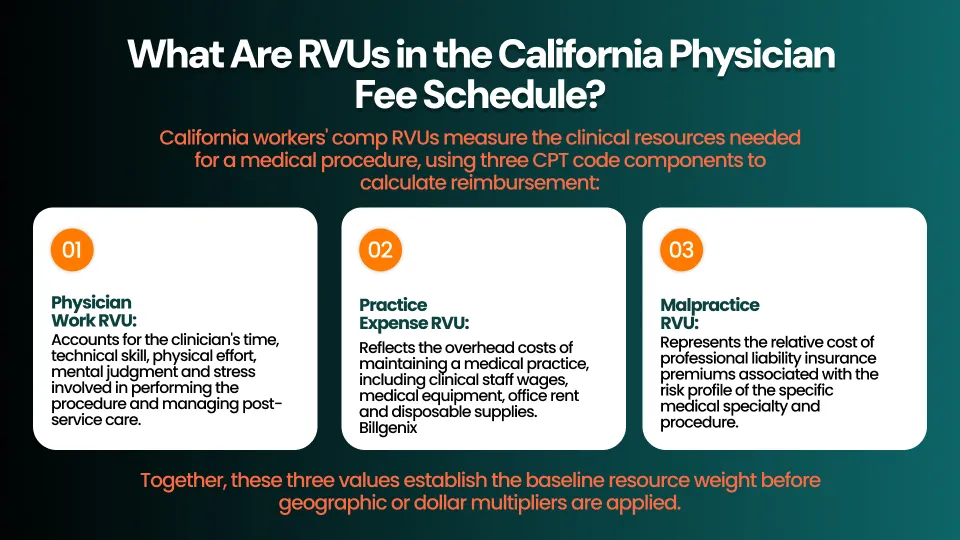
California workers' compensation RVUs measure the clinical resources required to deliver a specific medical service relative to other procedures. Every Current Procedural Terminology (CPT) code is assigned three distinct RVU components that form the foundation of California RVU reimbursement:
- Physician Work RVU: Accounts for the clinician's time, technical skill, physical effort, mental judgment and stress involved in performing the procedure and managing post-service care.
- Practice Expense RVU: Reflects the overhead costs of maintaining a medical practice, including clinical staff wages, medical equipment, office rent and disposable supplies. Billgenix
- Malpractice RVU: Represents the relative cost of professional liability insurance premiums associated with the risk profile of the specific medical specialty and procedure.
Together, these three values establish the baseline resource weight before geographic or dollar multipliers are applied.
3What Is the OMFS Conversion Factor in 2026?
The 2026 OMFS conversion factor is the statutory dollar multiplier that translates geographically adjusted RVUs into a maximum allowable dollar fee. While RVUs measure relative clinical effort, the conversion factor establishes the actual monetary value of each unit.
Effective for services rendered on or after March 1, 2026, the DWC raised the general physician conversion factor to $51.61 (up from $48.79). This adjustment reflects statutory inflation methodologies tied to the Medicare Economic Index (MEI) alongside federal Medicare payment updates. However, billing teams must always verify the exact multiplier in the official DWC regulations for the specific date of service as specialized categories like anesthesia utilize distinct conversion factors and locality rules.
4How Does GPCI Affect California OMFS Reimbursement?
Because overhead and staffing costs vary drastically between regions like Los Angeles, the Bay Area and rural counties, the OMFS applies a Geographic Practice Cost Index (GPCI) to localize payments. Each county or Medicare locality in California receives three separate GPCI multipliers:
- Work GPCI: Adjusts the Physician Work RVU to reflect regional variations in physician earnings and cost of living.
- Billgenix
- Practice Expense GPCI: Modifies the Practice Expense RVU based on local commercial real estate rates, utilities and clinical staff wages.
- Billgenix
- Malpractice GPCI: Scales the Malpractice RVU according to regional medical liability insurance rates.
Selecting the accurate service location zip code on a claim is critical. Billing under an administrative headquarters address rather than the actual clinic locality frequently triggers automated carrier down coding and incorrect OMFS physician reimbursement rates.
5How Is the 2026 Physician Fee Calculated?
For standard non-anesthesia physician services, medical billing reimbursement calculations follow a specific statutory formula defined under California Regulation 9789.12.2:
Base Maximum Fee = [(Physician Work RVU × Work GPCI) + (Practice Expense RVU × Practice Expense GPCI) + (Malpractice RVU × Malpractice GPCI)] × Conversion Factor (CF)
A crucial variable in this equation is the distinction between facility and non-facility rates. When a physician treats a patient in a private office (non-facility), the Practice Expense RVU is higher to cover clinical overhead and supplies. When the same service occurs in a hospital or ambulatory surgical center (facility), the Practice Expense RVU decreases because the facility absorbs those overhead expenses.
Additionally, this base formula does not apply universally to every OMFS category; payment modifiers, multiple-procedure reductions and California-specific ground rules can alter the final payable amount.
6What Changed in the 2026 California OMFS Updates?
Monitoring California medical fee schedule updates is essential because the DWC aligns state workers' compensation rules with ongoing federal changes through formal DWC Administrative Director Orders. Rather than following a rigid, uniform schedule, the DWC issues updates whenever federal modifications or state regulatory corrections take effect.
Effective Date | Key 2026 DWC Regulatory Changes |
March 1, 2026 | Major annual physician schedule update; increased general conversion factor to $51.61, adopted 2026 CPT codes, updated RVUs, revised telehealth lists, and raised California-specific WC report fees. |
April 1, 2026 | Adopted second-quarter Medicare RVU updates and revised coding edits for services rendered on or after April 1. |
July 1, 2026 | Implemented third-quarter Medicare RVU file (RVU26C), updated Procedure-to-Procedure (PTP) edits, and revised Medically Unlikely Edits (MUEs). |
Interim Orders | Additional Administrative Director Orders (such as October Q4 updates and Medi-Cal rate table revisions). |
Key operational shifts in 2026 include updated relative values across hundreds of CPT codes, revised telehealth eligibility rules, and stricter National Correct Coding Initiative (NCCI) Procedure-to-Procedure (PTP) and Medically Unlikely Edit (MUE) thresholds.
7How Do Fee Schedule Updates Affect Medical Billing?
Failing to load current DWC Administrative Director Orders into practice management software creates immediate revenue leakage. When billing systems rely on outdated RVU weights or prior-year conversion factors, teams submit claims with inaccurate expected reimbursement benchmarks.
Furthermore, billing deleted CPT codes or ignoring quarterly RVU updates and revised PTP/MUE edits results in automatic claim denials and protracted payment disputes. Even when claims pay, practices using stale fee tables cannot detect when workers' compensation carriers underpay or apply unauthorized network discounts. Consistent fee schedule maintenance ensures clean claim submission, accurate revenue forecasting and timely appeals on underpaid bills.
8Frequently Asked Questions
1. What are RVUs in the California OMFS?
Relative Value Units (RVUs) are numerical weights assigned to CPT codes that measure physician work, practice overhead and malpractice costs. California uses these Medicare-derived values to determine baseline service complexity before applying geographic and dollar multipliers.
2. How does the OMFS conversion factor work?
The Conversion Factor (CF) is a dollar multiplier set by the DWC. After multiplying a procedure's RVUs by local GPCI values, the combined total is multiplied by the conversion factor to establish the maximum allowable fee.
3. What is the difference between facility and non-facility reimbursement?
Non-facility rates apply to services rendered in a physician's private office and include higher practice expense RVUs for staff and supplies. Facility rates apply in hospital or surgical center settings and reimburse lower practice expenses because the facility provides the clinical infrastructure.
4. Does California update its physician fee schedule quarterly?
While the DWC regularly adopts Medicare's quarterly RVU updates and coding edits, changes are not strictly limited to quarterly intervals. The DWC issues interim Administrative Director Orders throughout the year whenever statutory adjustments or rate corrections are required.
5. Where can providers check the latest 2026 OMFS updates?
Providers can download current fee schedule files, conversion factors, and update orders directly from the official California DWC OMFS webpage.
9Conclusion
Navigating the California OMFS Physician Fee Schedule 2026 requires precise alignment between RVUs, local GPCI adjustments, current conversion factors and active DWC update orders. Keeping internal billing tables synchronized with every effective date protects your practice from underpayments and coding denials. To streamline complex claims and maximize reimbursements, explore Billgenix's specialized Workers' Compensation Billing Services, Medical Billing Services, Revenue Cycle Management Services and Medical Coding and Billing Support.

